Wayfair
Wayfair is a global e-commerce company specializing in furniture, home décor, and household goods, offering a large online catalogue across multiple brands. It operates a digital-first marketplace that connects customers with a wide network of suppliers. They serve millions of customers and 11,000+ suppliers globally.

I was the Lead Product Designer on the Inventory and Replenishment team on Wayfair’s Supplier Platform called Partner Home. Inventory refers to the items a supplier has in stock to sell (think of it as the goods in a store's backroom or warehouse). Replenishment is the process of ensuring there's enough stock to meet customer demand.
My work focused on designing tools that help over 11,000 suppliers keep goods in stock, forecast future sales, and replenish just enough inventory to meet that forecast.
Selected projects from my time at Wayfair.
FedEx Shipping for Wayfair Suppliers
ABOUT THE PROJECT
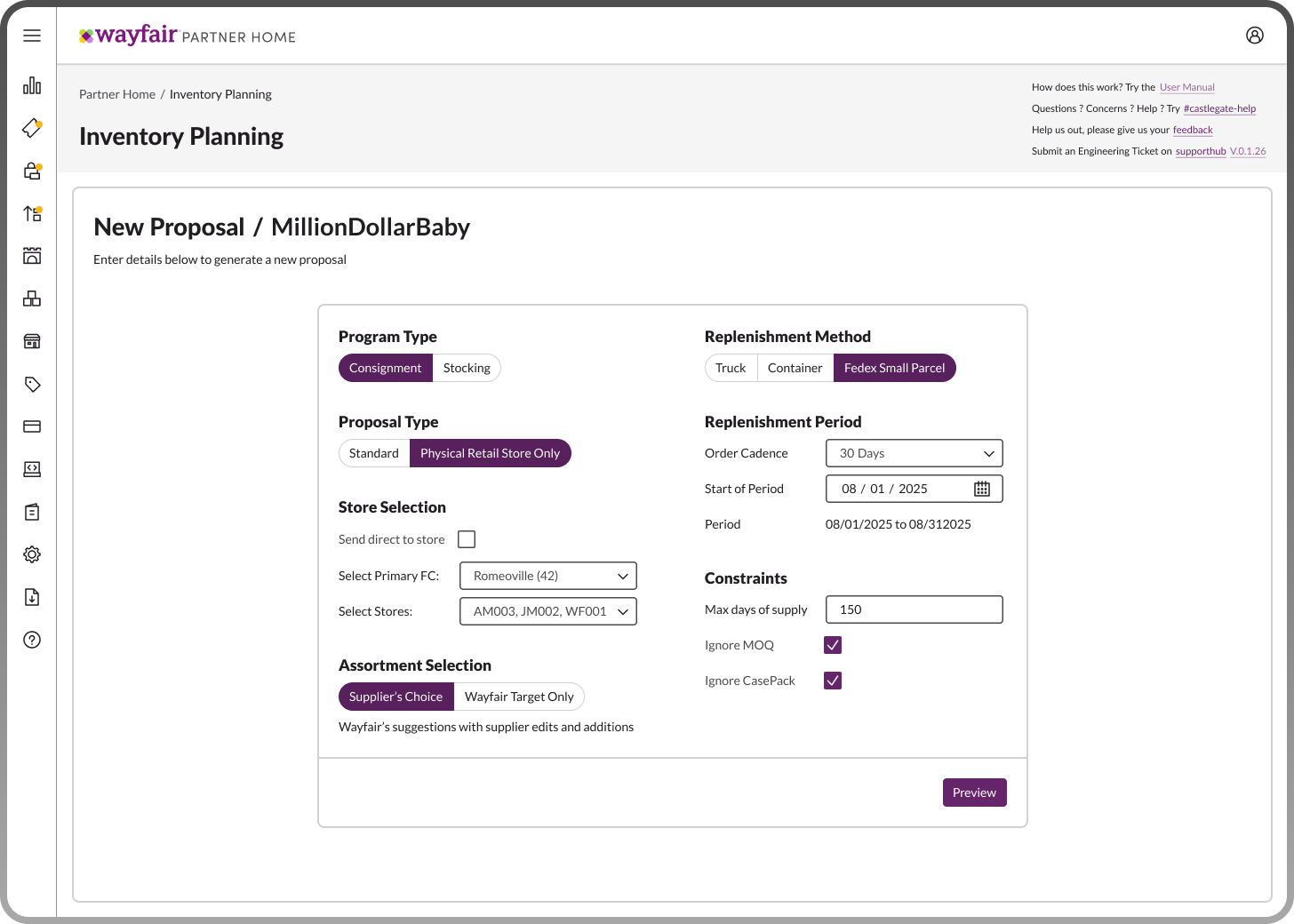
A new shipping flow in Wayfair's supplier platform (Partner Home) that lets suppliers send small parcels to Wayfair's fulfilment centres and stores via FedEx.
PROBLEM
The platform only supported bulk shipments, but suppliers often needed to send smaller, faster FedEx shipments, especially for new retail store openings where stock had to arrive quickly. With no proper FedEx flow in place, suppliers and internal planners relied on workarounds that left Wayfair without visibility into what was being shipped and forced suppliers to manually create FedEx labels in a separate external system. It also exposed Wayfair to legal compliance risk through one of the workarounds.
MY ROLE
Lead designer. I conducted discovery research, defined the UX strategy, created all mid-fidelity and high-fidelity mockups, and collaborated with product and product marketing on content design and copy.
SOLUTION
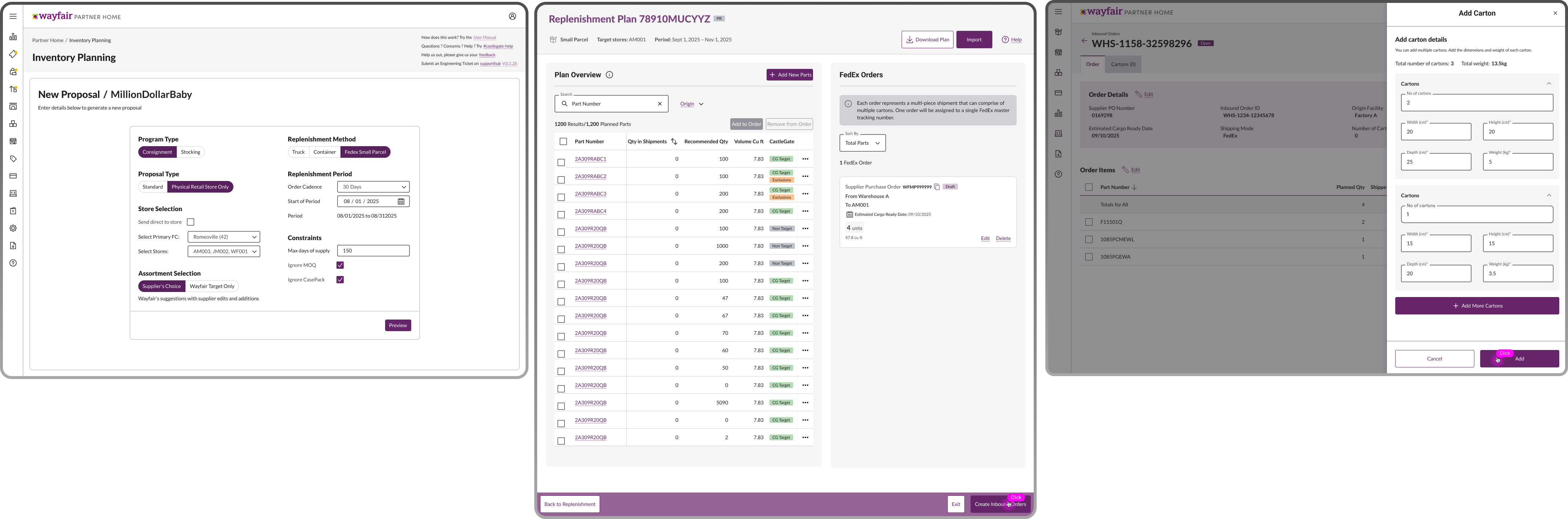
A dedicated small parcel shipping experience built directly into the supplier platform (Partner Home). Suppliers can now create small parcel orders with FedEx, break each order into individual boxes (with dimensions and weight), generate FedEx labels without leaving the platform, and track each box's status, replacing the previous external workarounds entirely.
IMPACT
This project increased the accurate receive rate at warehouses and stores from 89% to 96%, exceeding the 95% target. Eliminated the legal compliance risk from the workaround process, and unlocked box-level shipment tracking for the first time, which improved warehouse labor planning and opened up restocking to smaller suppliers who don't ship in full truckloads.
Smarter Product Discontinuation for Wayfair Suppliers
ABOUT THE PROJECT
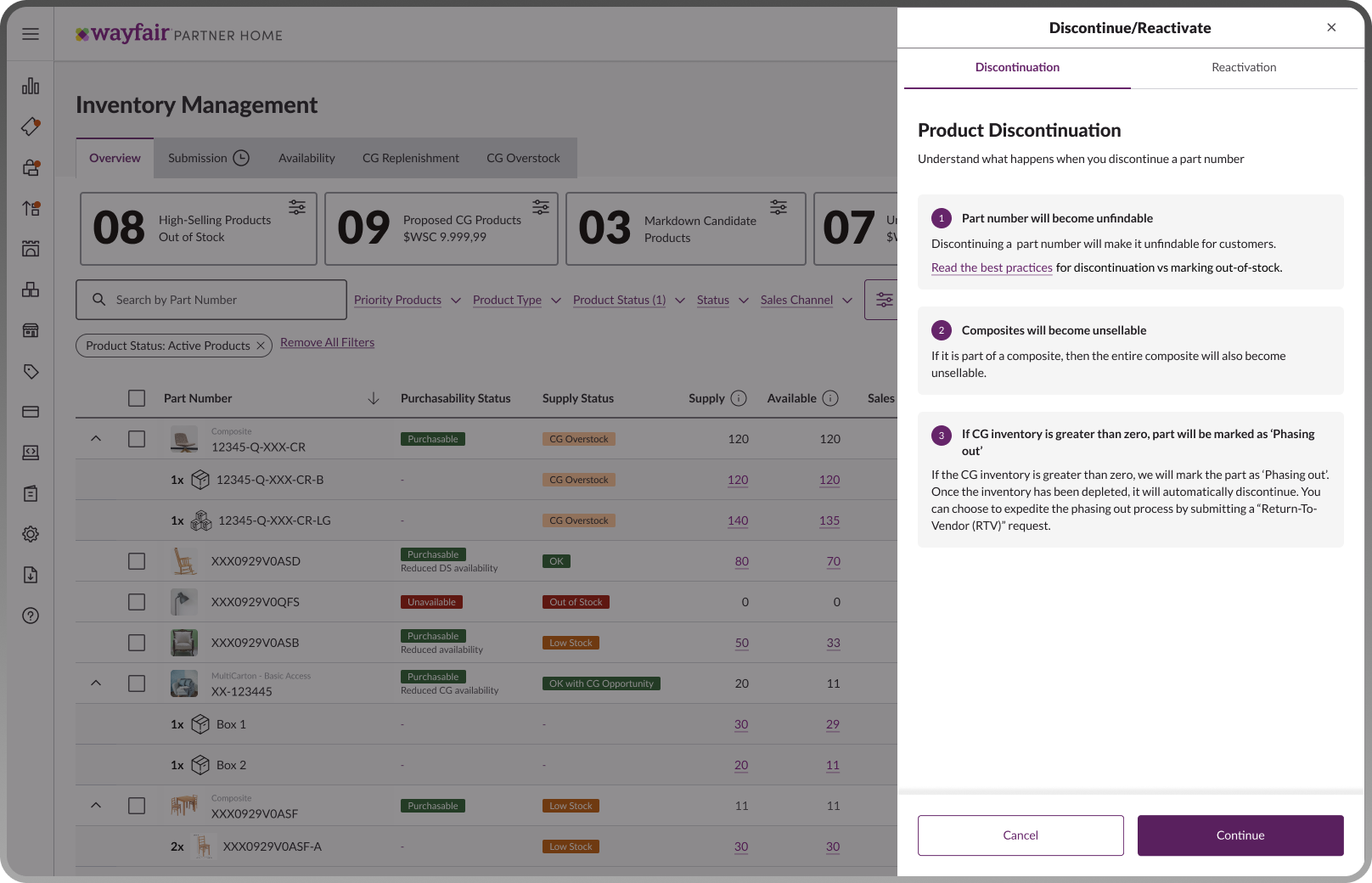
A new feature in Wayfair's supplier platform (Partner Home) that lets suppliers schedule a product for discontinuation at any time, even while inventory is still available, with the system automatically handling the final discontinuation once that inventory runs out.
PROBLEM
Suppliers could only discontinue a product once its warehouse inventory had completely run out. This forced them to constantly check stock levels and manually trigger discontinuation the moment inventory hit zero. If they missed that window, customers could keep ordering products that couldn't be fulfilled, leading to unfulfilled orders, customer disappointment, and lower performance scores for suppliers (which affected their ranking on the platform).
MY ROLE
Lead designer. I defined the UX strategy, created all low-fidelity and high-fidelity mockups, and supported engineering with implementation.
SOLUTION
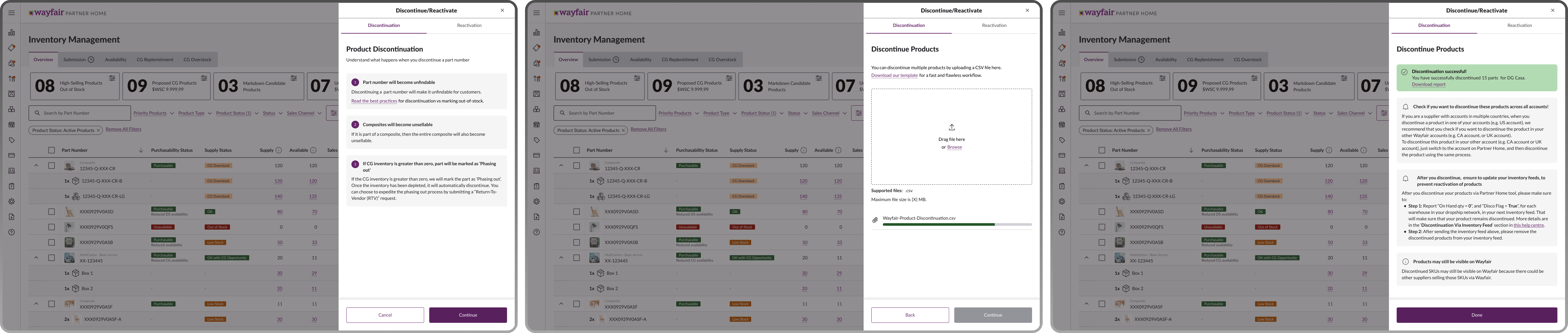
A new "Phasing Out" status that suppliers can apply to a product at any time, regardless of current stock levels. Once marked, the product stays available for purchase until the remaining inventory sells through, at which point the system automatically discontinues it. Suppliers can apply this in bulk via spreadsheet upload, see clear confirmation messages explaining what happened to each product, and cancel a phase-out if needed.
IMPACT
This feature replaced a manual, error-prone process where suppliers had to constantly monitor inventory and perfectly time their discontinuations, a workflow that frequently led to unfulfilled orders, which in turn caused customer disappointment, and damaged supplier performance scores. The new flow gave suppliers a reliable, set-it-and-forget-it way to retire products and protected customers from ordering items that couldn't be fulfilled.
Catching Stale Inventory Before It Costs Sales
ABOUT THE PROJECT
A new experience across Wayfair's supplier platform (Partner Home) and email notifications that flags when a supplier's inventory data has gone outdated, so they can refresh it before it leads to order issues on the storefront.
PROBLEM
Suppliers commit to sending Wayfair inventory updates at an agreed frequency. When those updates fall behind, the inventory shown on Wayfair's storefront drifts away from what's actually available, leading to customers ordering products that can't be fulfilled, or to products being shown as unavailable when stock actually exists.
MY ROLE
Lead designer. I owned the UX strategy, designed all high-fidelity screens in the flow, and designed new components that were added to the platform's component library.
SOLUTION
Two coordinated surfaces working together.
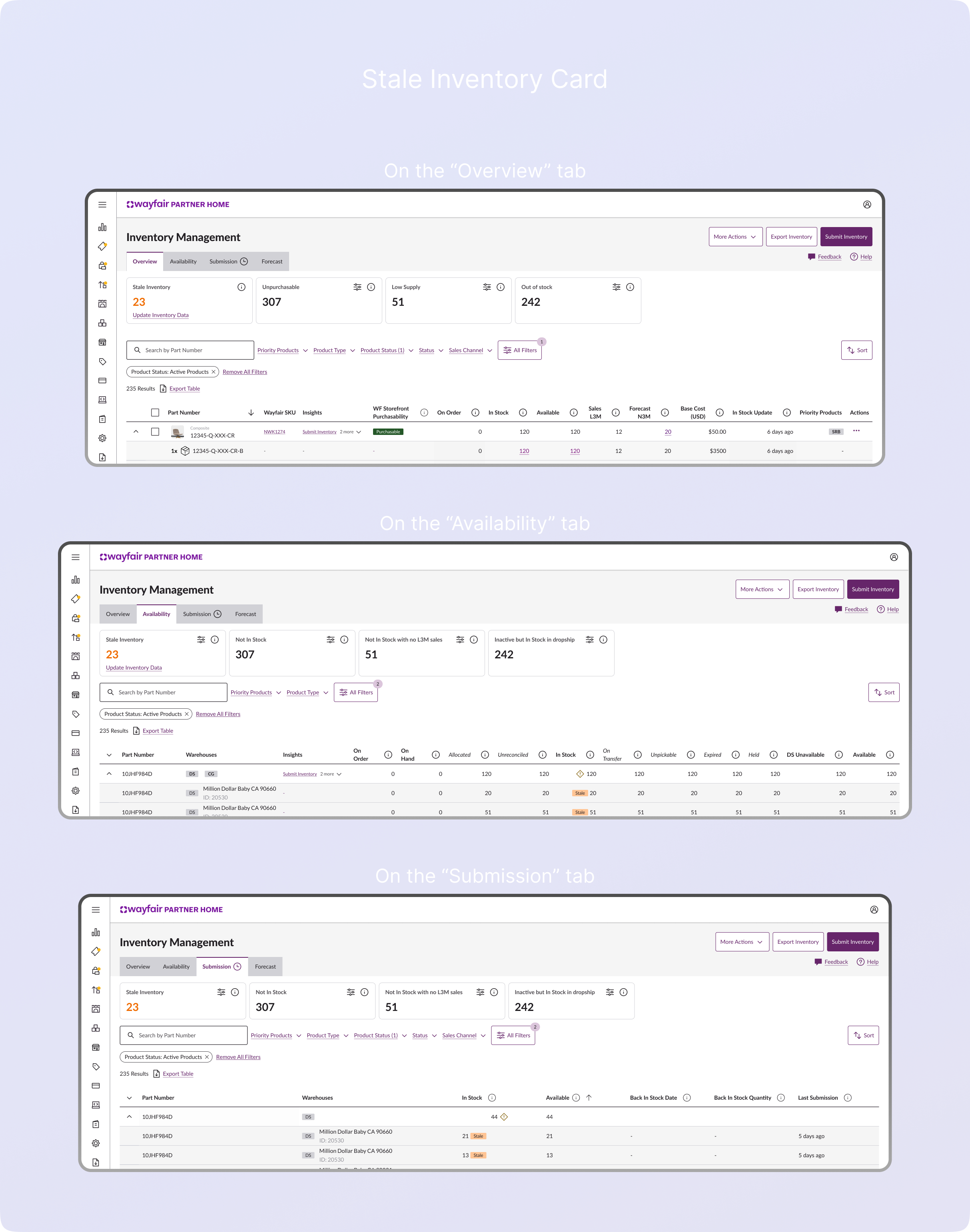
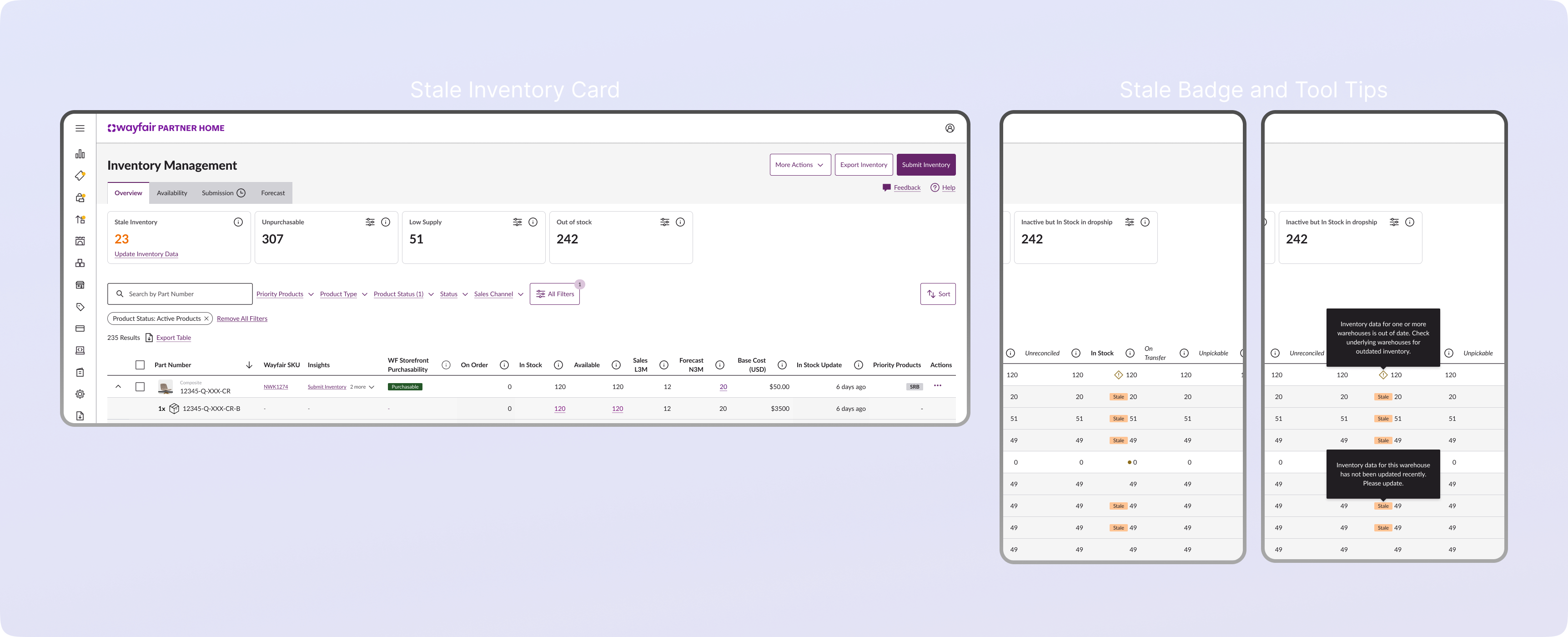
In the supplier platform (Partner Home), suppliers can now see exactly which of their products have stale inventory data, broken down by warehouse. A count card at the top of the inventory page shows how many products are affected, and new filters let suppliers quickly narrow down to the ones that need attention.
Alongside that, suppliers receive a daily email summarising their highest-priority stale products, prioritised by sales impact (top-selling items, promotional products, and anything stale for over a month).
IMPACT
This project addressed stale inventory, the biggest contributor to Wayfair's inaccurate inventory problem. Inaccurate inventory cost Wayfair 340,000 delayed orders and $59 million in cancelled sales in 2024 alone. The new flow gave suppliers direct visibility into their stale inventory both in-platform and via daily email, putting suppliers in control before it could cost sales.
Giving Wayfair Suppliers Control Over Their Notifications
ABOUT THE PROJECT
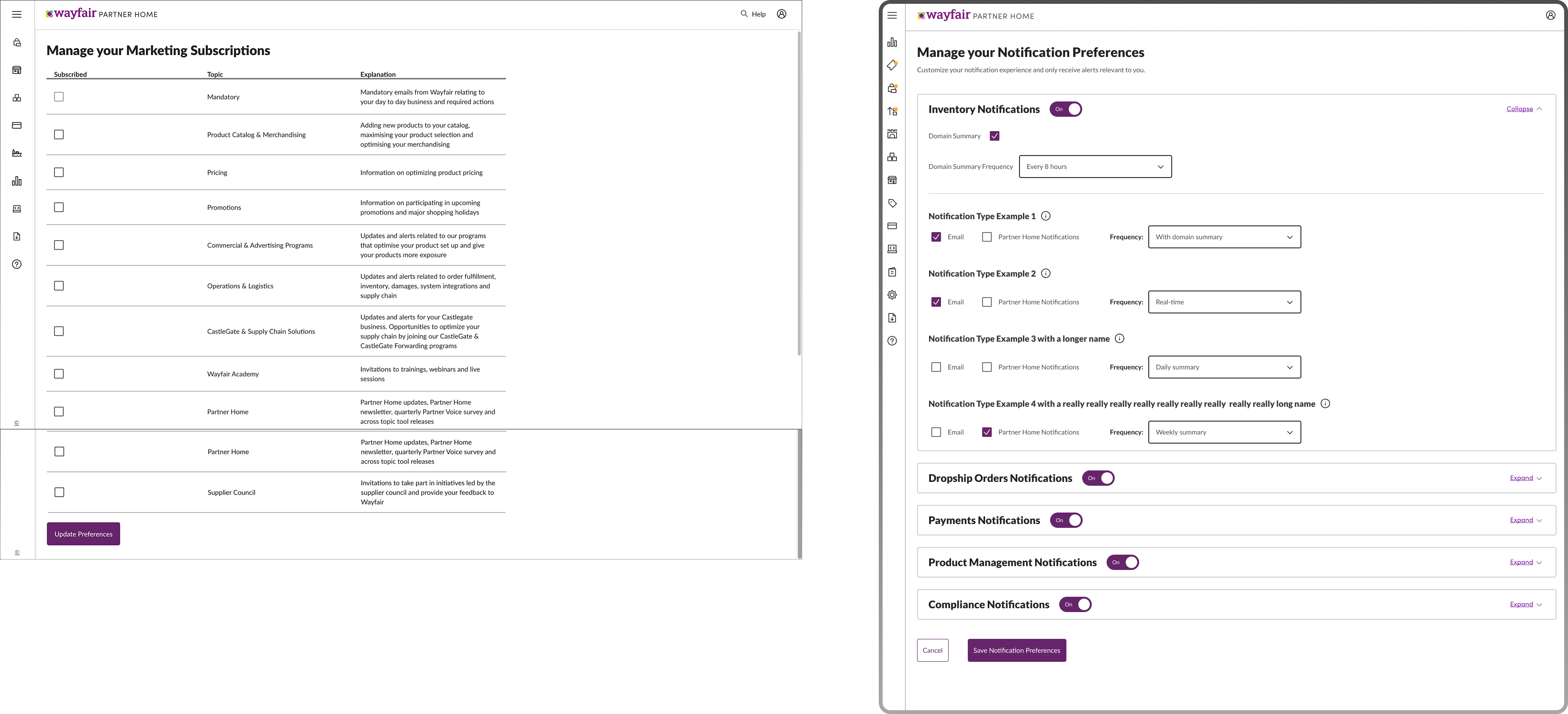
A redesign of how suppliers manage notifications on Wayfair's supplier platform (Partner Home), turning a basic email subscriptions page into a full notification preferences center, where suppliers can decide which notifications they receive, which channels they receive them on, and how often.
PROBLEM
Suppliers received a high volume of notifications from Wayfair across many areas of their operations (orders, inventory, payments, product management, compliance, and more), with very little control over what reached them or how. The existing preferences page only let them turn promotional emails on or off, leaving every other notification uncustomizable. This resulted in notification fatigue. Suppliers either tuned out their notifications entirely or missed important ones buried in the noise, which defeated the purpose of notifications.
MY ROLE
Lead designer. I defined the UX strategy and created multiple iterations of mid-fidelity and high-fidelity mockups for the flow.
SOLUTION
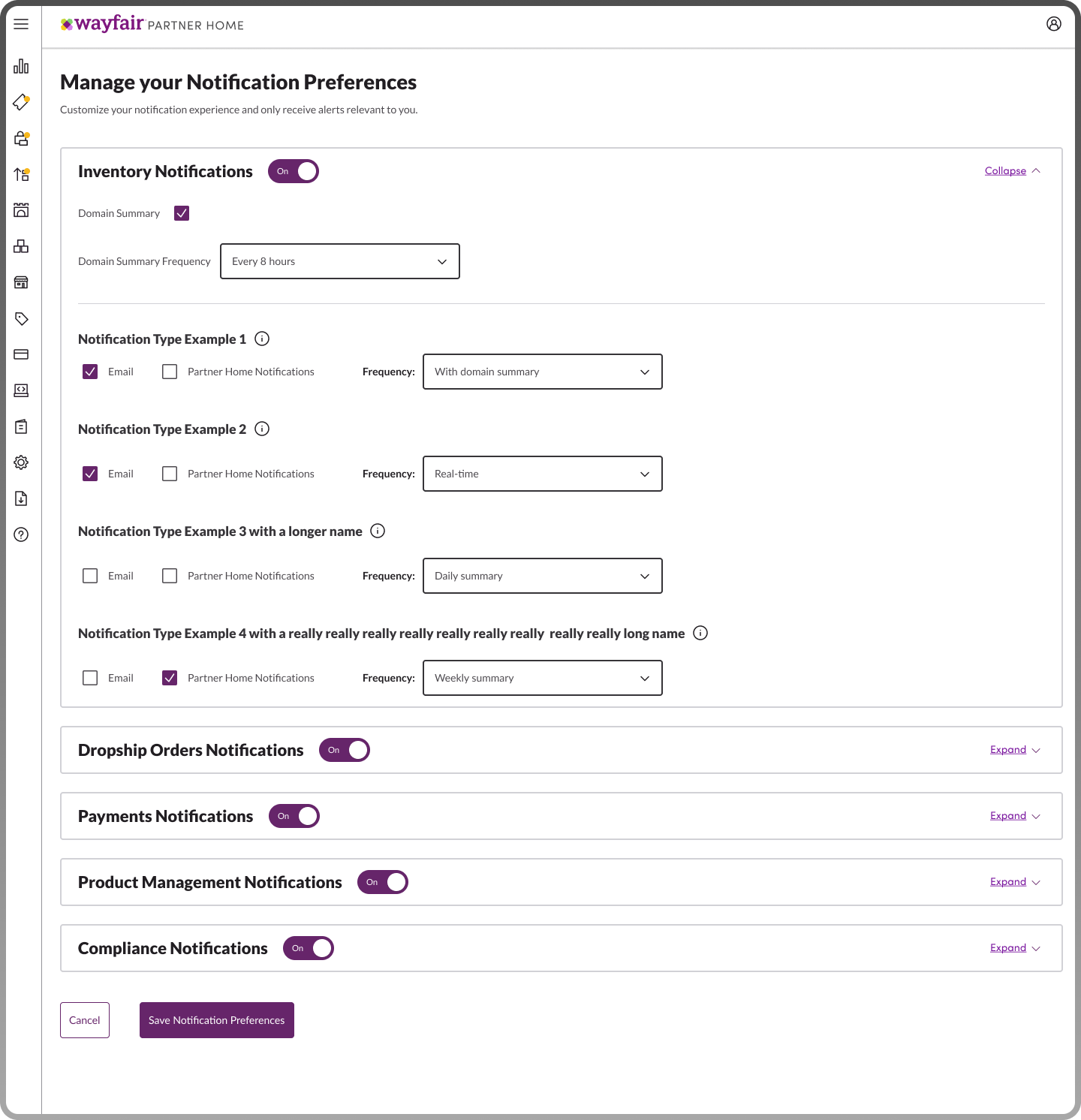
A new notification preferences center organised by area of the business (Inventory, Orders, Payments, Product Management, Compliance, and others), where suppliers can:
- Toggle each notification type on or off, with select-all and deselect-all options for each area.
- Choose which channel each notification arrives on, whether email, in-app on Partner Home, or both.
- Set the frequency for each one, either instant, daily digest, or weekly summary.
- See a short tooltip explaining what each notification is about, so they understand what they're choosing to keep or turn off.
IMPACT
This project was designed to address the notification fatigue suppliers experienced from receiving high volumes of unfiltered notifications across every part of their operations. By giving suppliers granular control over which notifications they receive, where they receive them, and how often, the new flow makes their notifications useful by only surfacing what's relevant to them.